
- This event has passed.
CHUQ-UL’s Neuroscience Axis’s NeuroForum: Dr Shawn Haley; Multi-hit models for Parkinson’s disease: Converging neuroimmune routes
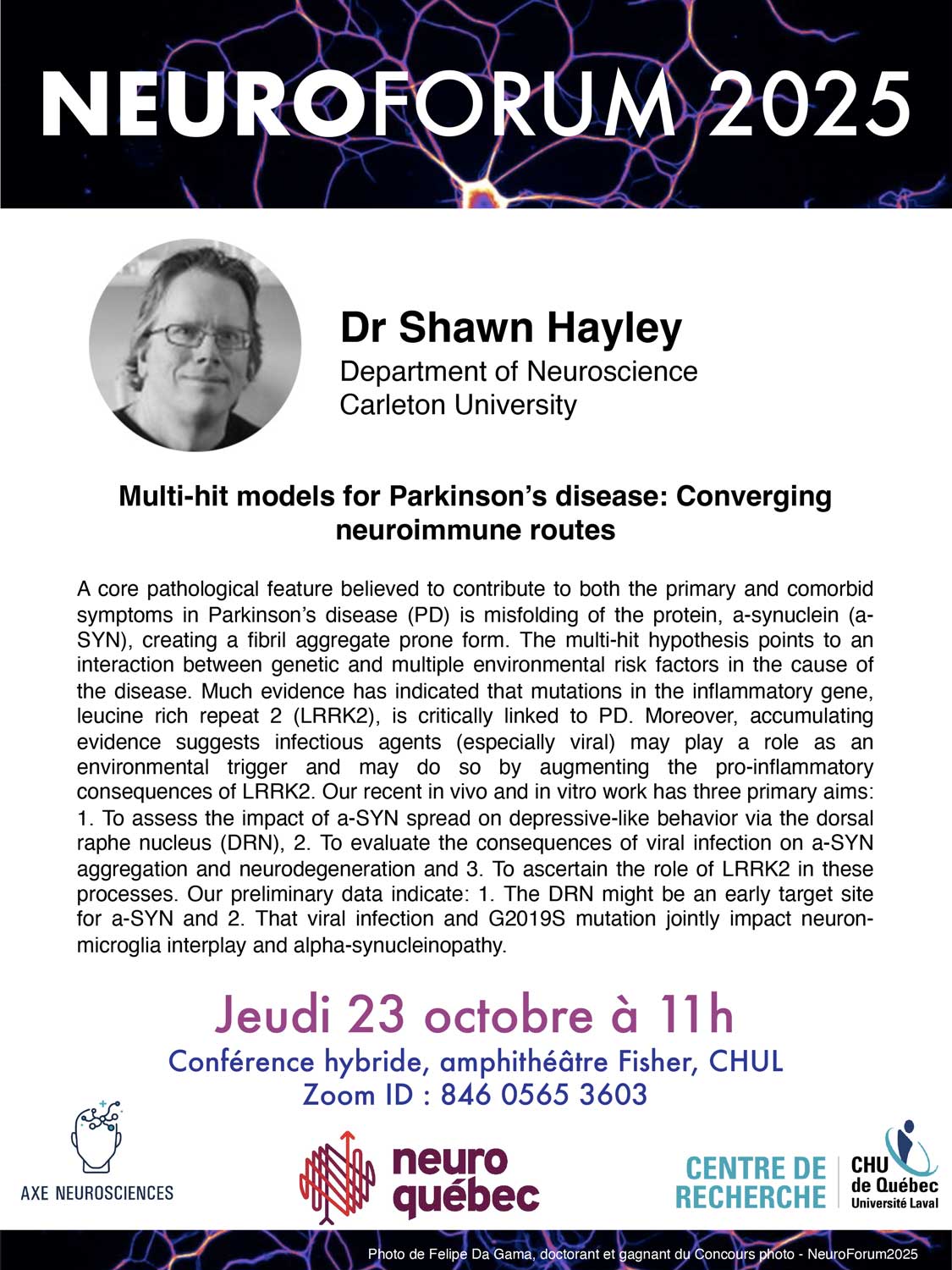
Dear all,
The Neurosciences axis invites you to the conference of Dr Shawn Hayley, Carleton University, Thursday, October 23 at 11 a.m.
The conference is offered in a hybrid format, in person at the CHUL, amphitheater Fisher and broadcast on zoom (https://us02web.zoom.us/j/84605653603).
For researchers who would like a discussion with the speaker please contact Julia Julia.Hernandez-Rapp@crchudequebec.ulaval.ca before October 10.
For students, a meeting with free lunch boxes is planned just after the conference if you want to discuss with him. Thank you for conytacting Julia Julia.Hernandez-Rapp@crchudequebec.ulaval.ca as soon as possible to register for this meeting, places are limited to 10 students.
Here is the title and summary of the presentation:
Title : Multi-hit models for Parkinson’s disease: Converging neuroimmune routes.
Abstract : Parkinson’s disease (PD) is characterized by the age-dependent emergence of motor disability and degeneration of the dopaminergic nigrostriatal pathway, along with non-motor behavioral disturbances (e.g. depression). A core pathological feature believed to contribute to both the primary and comorbid symptoms in PD is misfolding of the protein, a-synuclein (a-SYN), creating a fibril aggregate prone form. The multi-hit hypothesis points to an interaction between genetic and multiple environmental risk factors in the cause of the disease. Much evidence has indicated that mutations in the inflammatory gene, leucine rich repeat 2 (LRRK2), is critically linked to PD. Moreover, accumulating evidence suggests infectious agents (especially viral) may play a role as an environmental trigger and may do so by augmenting the pro-inflammatory consequences of LRRK2. Our recent in vivo and in vitro work has three primary aims: 1. To assess the impact of a-SYN spread on depressive-like behavior via the dorsal raphe nucleus (DRN), 2. To evaluate the consequences of viral infection on a-SYN aggregation and neurodegeneration and 3. To ascertain the role of LRRK2 in these processes. To this end, we found that intracerebroventricularly infused a-SYN fibrils impact the DRN and induce an early (possibly prodromal) depressive-like response in rodents. Secondly, we found that MHV coronaviral infection of primary midbrain neurons and microglia caused time-dependent a-SYN aggregation, neuronal damage and microglial activation. These effects were generally increased by the G2019S LRRK2 mutation. Hence, our preliminary data indicate: 1. The DRN might be an early target site for a-SYN and 2. That viral infection and G2019S mutation jointly impact neuron-microglia interplay and alpha-synucleinopathy.